No Beat, No Box: The Many Lives of Maddy
He can turn a traffic jam into a verse, a stranger into a story, a mistake into a lesson, and a network into an ecosystem. Rapper Maddy – Anshit Sharma, when he wants to disappear, Maddy, when he wants to light up the room, opens up about social currency, selfhood, faith, and the many lives a person can inhabit.
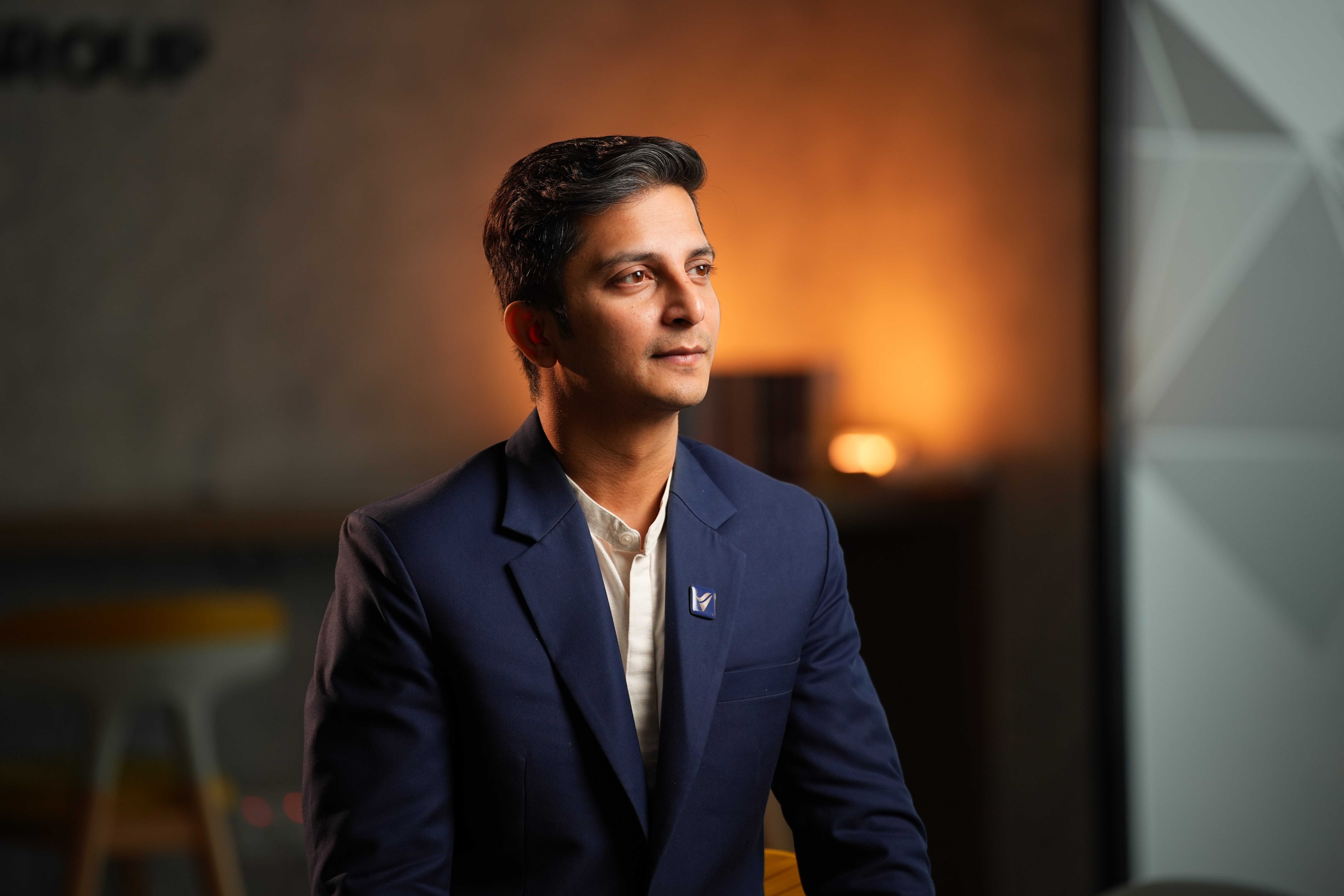
There is a specific, rehearsed armour one braces for when interviewing a rap artist who has dominated reality-TV screens on shows like MTV Splitsvilla and MTV Roadies. There is the expectation of carefully manicured anecdotes, familiar questions, and bulletproof sound bites. Instead, The Lives conversation with Rapper Maddy began with internet glitches. It gradually transcended into people, poetry, philosophy, faith, football, engineering, and traffic jams, before arriving, almost inevitably, at the person behind the persona.
“Look at me, Khushi,” he says with a lively grin that instantly resets the energy of the room (read, Zoom). “You are your own question. You are your own answer.”
His answers rarely stay where the question puts them. They move, connect, loop back, pick up an image and turn it into something else. There is a rhythm to it, and somewhere between Maddy the performer and Anshit the person, a philosophy emerges: one of remaining curious enough to keep moving.
It Takes a Village, indeed.
The conversation begins with something increasingly rare in a world where relationships are often reduced to numbers: people. Maddy speaks about how much networking has moved online, and about the difference between digital connection and the kind that is built slowly, physically, and organically.

“You can beat everything, but you cannot beat something organic.” He has learnt this through relationships and the slow accumulation of trust that a follow-up request cannot replace. Maddy adds, “Economic currency is something that if you’re ever deprived of, you can still build, but social currency is there to sustain you for days when economic currency cannot.” To complicate this understanding, Maddy interestingly posits a question juxtaposed against the common adage, “My only question to everyone who says ‘your network is your net-worth’ is: ‘Do you have a net-worth of networks?’ Here, networking transcends a collection of individual contacts to how often people across networks and ecosystems meet. “If a seed meets a seed, probably two trees. However, when the trees meet other trees, there are too many fruits. If you’re alone in the jungle, you will eventually starve. Even a jungle depends on a food cycle. Even a career depends on people. Even a person, perhaps, needs other people to become themselves fully.” Some connections open doors, and the right ones build rooms.
Before the Rap, There Was ‘Anshit’
Before the Rapper Maddy persona, the life of this artist started when he was ‘Anshit,’ a schoolboy.
I vividly remember my mother taking me to D.A.V Public School, Pushpanjali, for my admission to LKG, and there the principal asked me if I knew any poems. I said, “Yes, I know poems.” Later, she asked me, “Can you sing a song?”
So, he sang a Shankar Mahadevan song to the principal and to us, “Hawa hawa, e-hawa khushboo lutade.”
Reminiscing about his school days, he says, “Back in school, if I wanted to do something, I would first ask my friends if they would come or not. If they did, we would go as a group; otherwise, my plans were still never cancelled because of having to do something alone” There is a particular freedom in that approach: Go first. Let the others decide whether they want to follow.
“What if you lose out? What difference does it make? You have learnt something.”
In childhood, he taught his friend to play football, and his friend introduced him to rapping. “I distinctly remember I had written a poem for a girl I liked during my school, little did I know it was a ‘rap poem’ until my friend told me and hilariously the whole school eventually!” At that moment, the principal called Anshit and asked him to write a poem titled Revive for the school assembly the next day.
That ‘rap poem’ became a pivotal moment in Anshit’s career.
Checkmate is Optional
Maddy’s philosophy of self-determination is surprisingly domestic. “Even medicine,” he says, “doesn’t work on two people.” The prescription cannot be identical because the person is not. Perhaps this is why Maddy resists the language of universal advice. Experience, to him, is personal property. What failed for one person may work for another. What healed one person may do nothing for someone else. The only way to know is to live enough to find out.
Maddy speaks about poetry and performance without separating them from the rest of his life. “If you’re enjoying your career and what you do so much, it naturally seamlessly integrates into your life. If your profession is your passion or passion is your profession, you will love it. You will never feel there is a watch running.”

Maddy remembers a line he used during Splitsvilla: “It’s a game of chess, and everyone wants to win. Everyone is playing at their own game. So, play.” There is a certain lightness to the way he uses the language of games. Life itself, he clarifies, is not a game. But one can choose to play with it a little. “Who has forbidden you to play?” The same thinking appears when he talks about risk. He objects less to taking risks than to the negative meaning people have attached to the word itself. “Risk is a negative word. People take it as a negative word.” For Maddy, a word does not have to determine the outcome of an action. The decision comes first; the judgment comes later.
It’s only words, and words are all [Maddy] has…
When asked what Anshit does when there is no work, no music, and no audience, he remembers a moment in a taxi when a sher struck him, “Mila hoon bahut logon se aur bahut kam logon se hi mil paya hoon aaj tak.” He added another sher to it, “Suna hai, kahin kisine nishana maara hai, aur kahin koi baaz gira hai. To dekh Khushi meri taraf, mai asal mai raja hun, mera sirf taaj gira hai.”
Watch him mid-conversation, the moment an interview starts circling the predictable cadence of press bites, he shifts the register with a sher or a street-philosophical aphorism that instantly recalibrates the atmosphere. The shayari is not an embellishment or an interlude; it is his instrument of authority. It is how Anshit reclaims agency.

The Monk and the Main Character
If Maddy is the person the world knows, Anshit is the person he describes almost as an inside joke.
“Anshit doesn’t want to be out there.” Anshit reads philosophy. He reads the Gita. He is, in Maddy’s telling, ‘perfectly comfortable outside the machinery of attention.’ Maddy is something else altogether. “Maddy is somebody who is all about enjoying. He is all trance. He is his own Magan. He is a great Mawla.”

Perhaps that is because Maddy does not describe the two selves as opposites. Anshit is not the “real” person hiding behind the celebrity, nor is Maddy merely a manufactured public character. They appear to be two ways of inhabiting the same life. “He is his own Magan.” Anshit does not have to disappear for Maddy to exist, and Maddy does not have to perform for Anshit to have a life of his own.
A Fragrance That Stays
The people we meet rarely leave us exactly as they found us. Sometimes it is a phrase that stays, sometimes a habit, sometimes a way of seeing the world that quietly becomes our own. When the conversation turns to this idea of carrying people with us, Maddy says, “We are not the pieces of people. We are the essence of people.” A person is not broken into parts and carried around like a collection of memories. Instead, encounters leave something less tangible behind. Maddy explains it through an image that is almost deliberately ordinary: “When your soul gets so many fragrances, it makes you fragrant.” Somewhere along the way, the people we meet become part of the way we speak, think, remember and see.

Success, with Conditions Applied
Maddy is careful with the word success. “If people’s opinions impact you, then whatever success you have had, I will not say success, I will say progress, it comes to zero. You are not defined by their definition of success.” It is an idea that seems particularly suited to a life that refuses to follow one professional line. Aircraft maintenance engineering sits somewhere in the same biography as television, music, poetry, football and philosophy. On paper, the combination looks scattered. In conversation, Maddy makes it sound almost inevitable.
“Everyone's life is not linear.” There does not have to be a single thread running visibly through everything. Sometimes the connection becomes apparent only when one looks back. “The engineer and the rapper can exist in the same biography. So can the reader of the Gita and the reality-show contestant. One identity does not have to make another illegitimate,” Maddy says.

Jack of All. Maddy of Many.
People recognise Maddy before they remember him. He recalls being called “Beer Bicep” or “Sharman Joshi” by people who have seen him somewhere but cannot quite place his name. He does not seem particularly bothered. “I have been watching this game for so long that I won’t have that scene that I have to prove to someone. The more people know the person rather than the profile, the less important the number becomes. The more salams you will get, the more Namaste you will get.” Perhaps that is another version of social currency — one that cannot be counted until you are standing in a room where people remember you.
Perhaps that is also what makes Maddy difficult to reduce to a profile in the first place. Maddy has moved fluidly between worlds, simply because the idea of choosing only one identity seems almost unnatural to him. He studied aircraft maintenance engineering. He raps. He writes poetry. He plays football. He reads philosophy. He has appeared on television. He talks about faith. When asked about being an all-rounder, he does not describe it as a carefully constructed strategy. “We come from that age where our parents used to say that our child is an all-rounder.” There was no expectation then, he says, that a person had to find one niche and remain inside it. “There was no such thing as holding a niche and playing.”

Even the old phrase “Jack of all trades, master of nothing” does not trouble him particularly. “Jack of all trades, master of nothing is still better than master of something like that.” For Maddy, the different interests were never competing for space. “It was hand in hand. We did it together.” At one point, studying itself became a hobby. “Studying had become a hobby, and my hobby was going on so much that it felt like a job.” It is why he resists the idea that everyone must be pushed towards the same definition of achievement. “You can’t force someone to do something and force them to study.” There is no universal prescription here. There is only temperament. “To each their own.”




Newsletter
Subscribe for soulful stories
Subscribe to The Lives and never miss a story.
- Sponsored Ad -

Smarter tools for modern teams—powering faster workflows and better decisions every day.